Tuesday, February 26, 2013

In FFFocus: Unstuffing Unicorns with Aloonaluna


Watery Starve, a San Francisco-based micro press started in late 2012, deals in “limited and unique releases of music, writings, and art.” Label curator and artist, Lynn Fister, marries all of these interests together in the beautifully packaged and thoughtfully presented 4-way split cassette release, Taxidermy of Unicorns, that just came out. Taxidermy of Unicorns features some of the leading female voices within the experimental cassette underground, including Motion Sickness of Time Travel, Je Suis Le Petit Chevalier, Birds of Passage, and Fister’s own, Aloonaluna project. Over their respective c60 sides, each artist is able to stretch out their highly personalized take on modern folk song forms and abstract sound creation, yet a decidedly cohesive listening experience takes shape over the course of the entire release. This cohesiveness is also present in the artwork and in the accompanying booklet where Fister’s writings outline the connections between their work. We recently had a chance to ask Lynn some questions about the art, sound, and ideas behind Taxidermy of Unicorns.

---------------------------------------------------------------------------------------------------------------------------------

In the accompanying booklet for this release, you describe some of the shared qualities that you see between the four of you noting that, “These artists tend toward intuitive forms of music-making and delve into notions of the ambiguous female voice, whether through the vehicles of machine or body.” I would agree with that whole-heartedly and would say that this gives Taxidermy of Unicorns a very cohesive feel. In addition to these natural connections between the four of you, had you all discussed any sort of conceptual framework for this release prior to recording your individual sides?

Prior to this release, I think--all four of us--have followed each other’s music fairly closely. Well, at least I have with theirs, and each of us has collaborated previously with at least one of the group. I must say that FĂ©licia, Rachel and Alicia are some of the most gracious musicians to collaborate with--as not only do they make time for so many projects, but I think they really consider the other people involved when working on their projects. They are all rather adaptive and mercurial . . . besides being really caring, friendly and sensitive people. So, this is to say that we all are pretty much in tune with the others’ work. To answer your question, there really didn’t need to be an overriding conceptual framework; I think it was more an organic development, though we all shared our music files openly with each other throughout the process of creating music for Taxidermy of Unicorns. I also knew I wanted the title to be this right away, without even hearing or working on the music yet. So this might of also set the tone.

Rachel and I have joked about us having a telepathic connection before. It’s funny, because I did have the title in mind from the get-go and had not shared what I planned to call it with anybody quite yet. Rachel wrote an email, talking about the four-split, asking about a possible title. She suggested it have something to do with unicorns, as she had just finished a Murakami book that inspired her to think about its symbolism . . . And I was like, yes, exactly. But, of course, I am a bit dark and I was picturing a dead unicorn, stuffed for all to see, and mounted as a trophy. Ha. I once passed a unicorn taxidermy at a novelty curiosity shop, just its head. I stared at it for a really long time, my reflection on the shop window morphing into the white unicorn. I felt half Echo/half Narcissus. I am now reading Murakami’s IQ84 as of late, waiting to hear about unicorns.

I think there’s so much weight to the unsaid. The natural compass when working with other people is often enough. Sometimes words are used to conceptualize a space. Sometimes they need not be there at all. I feel like textural music is a lot like that. The divisiveness between spoken words and the unsaid are blurred. With a space like that, I think it is up to the listener to make up how they would like to relate to it. There can be as much similarity or difference as you want. I think one reading of Taxidermy of Unicorns is that the music is all very similar. Another could be is that it is all very different from each other.

In an interview I did with Frank Baugh (Sparkling Wide Pressure) last year, he suggested that the tape underground “feels like a folk art movement.” You sort of allude to this as well within your write-up in the booklet with Taxidermy of Unicorms. How did you come to participate in this “movement” and, perhaps, how has it motivated/inspired you as an artist?

I would totally agree with the tape underground being a folk art movement! Besides folk as a musical style being echoic in the experimental underground, I think of folk art--as a subversive form or way of thought. It's music made for and by the common person, though of course you can also see/hear folk influence in academia and the conservatory as well . . . and vice versa. Things are not so dichotomous of course. I see cassette making being a cheaper analog way to present music, subverting the established, contemporary norm of a proper release on CD and/or vinyl. You don’t need a big pocketbook to release a cassette. You don’t need to be a virtuoso pianist or have a professional production studio to make beautiful or thought-provoking music. Some of the best music is being released on cassette now, given how much cheaper it is than releasing on vinyl. It also subverts the trajectory towards digital releases (which I really don’t care about; my mp3s are all dead to me, ha). This being said, I still like vinyl and would like to release some one day for others and my own music. But that doesn’t make the release better just because it’s on vinyl, just because someone spent more money on its release. It does look pretty sexy though! However, I still don’t know why people don’t take cassettes as seriously as a vinyl or CD release, just because of format and maybe limited distribution . . . I know, I know, I’m preaching to the choir.

So how did I get into this? Initially, I never really searched outward when making music past my immediate local community. That was before my move in 2010 to San Francisco. Where I lived for 10 years in Tallahassee, Florida, there’s a pretty strong and supportive music community, and I really didn’t have a desire to. When I moved to San Francisco, I lost this sort of artistic community I felt I had in Florida. I feel, and still do feel, very isolated in San Francisco, being a really established and competitive city. Today, I just got a letter from my friend Angela (I named a song after her on Taxidermy). She lived in San Francisco for a short time and is now back in Florida. She alluded to being back in the womb, and why, why would you ever want to go anywhere else perhaps. That moved me. She’s an incredible magic-realist painter and scientific illustrator and I miss her. I love Tallahassee. I loved it when I lived on a dock house with hardly any neighbors and moon jellies would wash up on the marsh.

Sometimes I’m here and I feel swallowed into a soulless void. These people are all trying to make it in a very beautiful, urban and very expensive context. It has become so unattainable for success/growth here, because it caters to an elite. Only the uber-rich can even buy a home in San Francisco. That’s gross. So, I found myself becoming more introverted and becoming less interested in the Bay Area art scene. I know I have only cupped my palm to my mouth and whispered at the surface, and there is definitely a lot of diversity here, but it doesn’t seem very community oriented at all; it seems very guarded. Ha, maybe I’m just bitter because no one seems interested in what I’m doing here. I don't know if it’s bitter or just an apathy that washes over you.

Because of my alienation toward my environment, I delved into my own head more. I've made more recorded music than ever. That’s also when I started to reach out to other labels and other artists for a sense of community. I am really grateful that Hooker Vision took me into their family! Because of them, I was able to start developing new friendships that have become very meaningful to me. I came to San Francisco not knowing anybody and with not a lot of connectivity, and I will leave here very soon with still not many close friendships in San Francisco, but so many have been built elsewhere. Weird how that works, but I guess that’s the internet. We can butterfly kiss with our eyelashes across oceans. And when I leave come summer, maybe only then I will finally meet and connect with San Francisco peeps. I’ll be like dayum, why did I move? Ha, probably not . . . I actually am really, really excited to move. New Orleans is whispering my name, and that city is so captivating.


The artwork and overall presentation of Taxidermy of Unicorns is impressive. Both the stitched and threaded elements on the cover and the collage art contained within are unique to every set of tapes. In an edition of 200, that must have been quite an undertaking? As a visual artist, does the immediacy and scale of things that tapes/tape culture provide(s) inspire you?

Yes, I’d say I’m very inspired by tape culture! I also really enjoy crafting, playing with glue, collaging, painting, etc. Curating a label marries these two deepset interests of mine: music and visual art. I don’t know if Watery Starve is forever, or even if playing music is something I’ll keep doing, but it keeps me alive and inspired for now.

In regards to the actual undertaking of making everything different in a pressing. . . Well, part of it is that I simply want every object to be special/unique to whoever’s hands it may land in. Someone throws it in the trash, someone finds it in the rubble. It was meant for them. It’s the only one. The other side of it is that I am really drawn to Gestalt psychology. Somehow, I think by creating relatively similar but unique artworks again and again leads to a more expansive whole as a larger artwork. Yip, I keep telling myself that with an edition of 200! 200 collages deep, a decrepit hunchback and my fingers rubber cemented together like I’m a crab.

I see the debate over there being “too much music” nowadays being played out over the internet on a regular basis. In the booklet, you take a favorable stance on the current musical climate stating that, “. . . access to recording and distribution via the internet has made art more readily available – and music is just getting better and better because of this access, as more voices than ever are able to surface hierarchical tropes.” What do you say to those who often cite the diminishing “quality” of music because of this access? 

I read somewhere once, that many people were really skeptical of the printing press when it first came out, because now anyone, anywhere could make books, print text, etc. They criticized the ease it would take to make a book, and now it gave access to more people to both write and read more books. I feel like privileged people always want to keep a lasso on the cultural canon, and a book-- a thing of the elite-- was now becoming a democratized vehicle for information. And people with cerulean or clergy blood running through their veins were crying because printing became vulgar. Hey, I don't have the time or the desire to read every book, sure, but I'm glad they are there. The more access, the more points of view . . . why would you want to exclude? Why would you want to hide your ugly stepsister under the stairs? Maybe I would find her beautiful? Maybe she just needs the sun to grow a little? Maybe we all do . . . 

Well, a definite parallel here to the printing press is the internet. Sure, the internet means that you can basically upload anything, (same argument for any form of media!) but you know you can pick and choose how you spend your time. It doesn't diminish the things you do connect with and learn from. I don't know, I feel really inspired by all these people creating. Even if I'm not a fan, I want them to create . . . and it's cool we can share it easily! I also do want to point out too, people also didn't suddenly stop making quality work, because it is easier to document and upload.

Anyway, I think it's sad that people think just because there's more, there's less worth. It’s like they want to harness a cultural canon or something . . . Keep the lasso on the moon! It's mine; it's not yours even though we both sit under it! Wow, it's a fantasy to think that only a few people are doing significant things. Geez, I'm such a commie, ha.

Not to change the subject, but what is documented really makes me think about what is undocumented. It's kind of like the unsaid. Maybe that's a different topic. Sometimes, though, it is nice to just go into the woods and play a song--or maybe not even a song per se--for no one but yourself and the trees. Ephemeral, undocumented moments. Can you believe it? Guess you'd have to go way far into the woods and under a canopy. Don't let the street or google camera catch you!

Monday, February 18, 2013

Through Dreams Beyond Humans: An Interpretation of Lumerians by Nicholas Zettel


Psychedelic music means “mind-manifesting” or “soul-manifesting,” an unfolding, or a becoming, an activity where the mind or soul can experience itself. The forms of psychedelic music fit this task, typically using repetition, extensive songs, and layers of sound to encourage reflection, to build a rich musical experience. One of the wonders of perception is that for each repetition of the same, each new point in time allows us to reflect on that experience. In this way, repetition in music builds fields for reflection and unfolding.

Frequently, psychedelic bands are compared to spacey or otherworldly phenomena, which translates the music’s potential for becoming into a realm that is entirely outside ourselves. Given the potential for psychedelic music to build templates for reflection and becoming, this focus on space or otherworldly features draws attention away from the ability of psychedelic music to transform our understanding or experience. Perhaps the best psychedelic music yields entirely internal rewards, rewards that encourage our minds, souls, our being to harmony or transcendence. Lumerians offer one such project, employing multiple releases and diverse sounds to explore the purposes of vitality (or, life-itself) and human creativity.

From critical vantage points, Oakland’s Lumerians are typically connected with otherworldly forms of psychedelic music, or space-rock. Throughout the course of 2012, Lumerians provided a set of EPs and a cassette that challenged their foundation of repetitive, driving rock music on their 2011 LP, Transmalinnia (Knitting Factory). While the second side of Transmalinnia dove into instrumentals that replicated the feeling of dream-states, the first side found the group translating their instrumental strengths into relatively short, catchy rock songs. The group’s execution of rhythmic excursions and organ and synth flourishes within compact statements was a testament to their songwriting ability, but their extended compositions on the second side would foreshadow their future. Taken in the context of their statement of purpose on Transmalinnia, the two shades of their sound would only be the beginning of their journey. This journey shows stronger ties to internal exploration, rather than otherworldly space rock.


Between their 2011 and 2012 releases, Lumerians explored their musical structures, backgrounds, and foundations, while completing the logic to their creative philosophy. Where the group’s philosophical and musical goals collide stands an underreported element of their music. While music fans focus on their spacey sonic developments, the group’s creative vision is typically not covered or explored. On Transmalinnia, for instance, the band offered a sonic program to translate the artistic vision of Eugene von Bruenchenhein into musical form. Similarly, their most recent releases offer detailed philosophical nuggets (or, opportunities for reflection).

While many psychedelic bands are christened with half-hearted, pass-the-bong colloquialisms, Lumerians offer a comprehensive creative vision alongside their music. Given the group’s musical development within their 2012 releases, their philosophical vision cannot be separated from their musical accomplishments. While one can certainly enjoy their music without thinking about their creative vision, their comprehensive vision enhances the experience of their music. Through their vision, we can understand how Lumerians stepped from celebrating the art of von Bruenchenhein, a man that created “a world of dreams, ideas, and visions traveling to far off undiscovered worlds beyond earth,” to exploring the structures and textures that allow us to experience alternate modes of consciousness. In this regard, Lumerians’ psychedelia is truly a manifestation of soul.

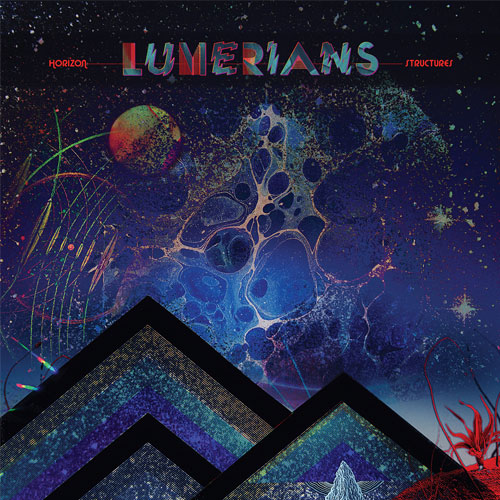
On their 2012 EP, Horizon Structures (Knitting Factory), Lumerians closed the year with a wicked set of angular, synth-driven dance music. One of the elements that sets Lumerians apart from other psychedelic acts is their embrace of key-based songs, as well as their robust approach to percussion. Accompanying their latest EP, the group offered another specific scenario for celebration and consideration (from their press summary at Knitting Factory records):

“Lumerians Horizon Structures EP leads off side A with 
“The Bloom” -- a long-fused charge of anti-apocalypse 
rock. Change is not the end. Life persists. The world is not 
ending, but YOU are. The notion of apocalypse places undue 
significance to the brief tenure of Homo sapiens. “Wintersong” 
affirms preparedness is acceptance of the inevitable. Side B 
closes with two heavily synth layered dance numbers. 
“Tawazula” and “Lazer Barn,” dances of creation and 
destruction in that order and out of order.”

Combined with Transmalinnia’s exploration of dreams, ideas, and visions traveling to undiscovered worlds, one might be forgiven for considering Lumerians to be spacey contributors to the psychedelic movement. Yet, their 2012 work deserves more attention for its emphasis on the earth itself, especially the idea that places the apocalypse in the center of a life-persisting change on earth. Not a change in which we focus on our own demise, but perhaps one in which we embrace the triumph of life in all its formations. Here we uncover the depth of vitality, and affirm that life itself persists in ways beyond our own understanding or existence. Accompanying their framework that embraces the use of dreams -- especially using forms of art to explore a world of dreams, ideas, and visions -- Lumerians add another dimension to their purposeful rock. We can use these artistic tools to explore life itself.

Telos is a purpose, or an end. One common mistake people make when they argue against telos is using the assumption that “an end” or “a purpose” results in some sort of pre-determination. Naturally, it is difficult for humans to wrap their minds around the idea that they are driven toward greater purposes without feeling that their ability to act or think is impaired. We want to feel “free” in some significant way --which, in itself, might suggest some specific human purpose -- but we do not want to focus specifically on the ends that humankind can achieve. Our own skepticism, or our perception of moral ambiguity in the world, leads us to ask, “whose end, or whose purpose?” How can we fully understand a greater human purpose without falling prey to humans that mislead us about our purposes?


In this regard, Lumerians’ embrace of dreams, exploring a world of ideals, as well as purposes or ends that disconnect the earth from humans, or disconnect our own sense of importance from vitality or life itself, provide a strong template for thinking about purpose. Remarkably, the goals of their releases in 2012 correspond with their philosophical statements. Between Transmalinnia and Horizon Structures, the group used Transmissions from the Telos: Vol IV EP (Permanent / Hands in the Dark) and The Weaning and The Dreaming tape (Sanity Muffin) to explore their own vision, expose the structures to their song-oriented LPs and EPs, to unveil their logic.

Following the second half of Transmalinnia, the four untitled cuts on Transmissions from the Telos show the band moving deeper into their instrumental territory. Here, the group combines laid-back grooves that show the fall-out of the dense sound of their LP, instead opting for rollicking percussion and playful key sequences. Alongside a playful fusion of psychedelic and jazz instrumental sounds on Transmissions…, the group present longform ragas and expansive, dark drones. It almost sounds like the band drew from each individual element that appeared on their LP, and expanded those elements into their own statements. With these instrumental sequences, Lumerians stretched their world, and added several different vantage points or signposts to their vision.

We can understand how to expand these vantage points by exploring the extreme poles. On The Weaning and The Dreaming cassette, the group presented two tantalizing titles for their tape manipulation compositions: “Consciousness without an Object,” and, “An Object without Consciousness.” Multiple sources have written about how the group built these compositions, which involved recording percussion, synth, and bass parts both forwards-and-backwards; each side of the tape is the full piece played in both directions (I call them “compositions,” even though there is basically one performance or construction, because the end result of the active tape manipulation is quite different on both sides. One wouldn’t necessarily know that it’s the same performance played forwards and backwards unless they were told). Their titles for these compositions provide the extreme poles for expanding our vantage points for exploring our purpose.


In philosophy, there are two extreme poles of perception that receive a lot of attention (and, form most traditional problems): realism and idealism. In their most exaggerated forms, realism upholds some realm of objects that exist independently of consciousness, while the most extreme idealists uphold perceivable realms that only exist through mind or consciousness. While these are extreme reductions on my part, Lumerians’ explorations of these two sides of reality are rich and continue to unfold with multiple listens. “Consciousness without an Object” leans heavily on sparse, backwards percussion, ultimately presenting structural outlines that lead into sparse synth drones and shimmering flourishes. These percussive blips, decaying in a surreal way thanks to the backwards tape, are beyond ritual or beyond repetition; they unleash sheer creativity, presenting a borderless plane for thought. By contrast, “An Object without Consciousness” is frantic, direct, vital, and engaging, emphasizing immediate, concrete experience that channels the rumbling, rattling hum of a world that exists through sheer independence.

These vantage points showcase numerous points of origin for a purpose-driven project. We need not conclude that humans striving toward a purpose results in one specific outcome. Rather, Lumerians show a strong communion with purpose-oriented projects by embracing the potential of each outcome, and ultimately, embracing the process that leads to those purposes. For this reason, Lumerians are one of the strongest psychedelic acts, not simply because their music corresponds to their philosophical and artistic vision, but also because their music offers a template for exploration that ultimately leads to action. This is why it’s important to take Lumerians’ philosophical hints seriously: if we follow their cues, and use our dreams, ideas, and visions to explore the world, and we investigate our purpose in a way that upholds life-itself (instead of simply upholding human existence), we can more meaningfully orient ourselves to the people, companions, objects, and places in our lives.

It is not a sucker’s game to associate psychedelic music with soul-building or mind-building exercises. Lumerians prove that through psychedelic exploration, we have a strong set of tools, sounds, and artistic forms that can orient ourselves to our universe. This orientation can ultimately lead us to better understand life and, as a result, become better humans, truly manifesting mind and soul.

Nicholas Zettel is a former contributing writer for Foxy Digitalis. He will be joining the rest of the Foxy D crew in the move over to the forthcoming Decoder website.

Sunday, February 17, 2013

FFFreakout #351 (Aired on 2/14/13)

Jack White "Take Me With You When You Go" from Blunderbuss
Yo La Tengo "Is That Enough" from Fade
Joey Scarbury "The Theme from The Greatest American Hero" (Believe It or Not)
Kraftwerk "The Model" from The Man-Machine
Billy Paul "Am I Black Enough For You" from 360 Degrees of Billy Paul
A.C. Newman "I'm Not Talking" from Shut Down the Streets
Swans "The Seer Returns" from The Seer
Goat "Disco Fever" from World Music
Thee Headcoats "She's Fine She's Mine" from Knights of the Baskerville
Holly Herndon "Fade" from Movement
Big Star "I'm In Love With A Girl" from Keep An Eye On the Sky
The Cactus Brothers "Lost John Deer" from S/T 

Tuesday, February 12, 2013

FFFoxy Podcast #13


Piper Spray “Blaster” Telegraph CS (Orange Milk
RM74 “Spineless” Two Angles of a Triangle 2CD (Utech) [7.46]
Motion Sickness of Time Travel “Something to Find” split w/ Imperial Topaz CS (Tranquility Tapes) [12.00]
Call Back the Giants “On the Forth Day” Incidents of Travel 12” (White Denim) [23.55]
Je Suis Le Petit Chevalier “The Names” Dark Morse CS* (Shelter Press) [29.03]
Messages “Smoke Photo” Message Bag 2LP (De Stijl) [34.02]
Razen + Andrew Liles “Rabies Gum” Rope House Temper CD* (Kraak) [40.25]
The Lay Llamas “Space Jungle Mantra” S/T CS* (Jozik) [44.55]
Creation VI “Well Spring” Pantheophania CS (Cae-sur-a) [52.35]
Lazy Magnet “Rabbit Magicians . . . / Brain O' Made . .” Revisionist Desperate 3xCDr (self-released) [52.52]
Alastair Galbraith “One Method” Cry LP* reissue (Mie Music) [1.02.25] 
Michael Pisaro, Oswald Egger, Julia Holter excerpt from The Middle of Life (Die ganze Zeit) CD (Gravity Wave
Robert Turman “Reflux” Beyond Painting 2LP (Fabrica) [1.08.52]
Gog “Tasks Which Destroy Body and Soul” Ironworks LP (Utech) [1.20.40]
Remnants “Two Track String Loop” Surface Tension CS (Mazurka Editions) [1.27.14]
FNL “01” FNL CDr (Nada) [1.32.27]
Henry Dawson “Elmira Love” Brain Love CS (Orange Milk) [1.35.25]
Reed Ghazala “Silence the Tongues of Prophecy” (excerpt) Gravikords, Whirlies & Pyrophones CD (Ellipsis Arts) [1.38.00]
Mark Bradley “In” (Track #1) Temple Music CS (Golden Cloud Tapes) [1.42.42]
Chapels “It Was Snowing . . . " (excerpt) split w/ The Transplant Mountains CS (House of Alchemy) [1.45.36]
Sir Richard Bishop “Boxcar Serenade” The Unrock Tapes LP (Unrock) [1.55.18]


As mentioned at the start of this week’s podcast, with Foxy Digitalis shutting down its operations, we will, naturally and quite sadly, no longer be posting the FFFoxy Podcast on that site any more. As I’m guessing many of you that check out this blog already know, however, the Foxy Digitalis crew will be joining forces with Decoder to form a new website under the Decoder banner in the weeks ahead. While I’m not aware of all of the specifics at this point, I can tell you with 100% certainty that the FFFoxy Podcast will live on both here and over at the new Decoder site. There will be no significant changes to what we do: we are still going to do artist and label features; we are still going to have in-studio guests and performances; we are still going to “dig deeper into underground and experimental music from the past and present.” Secondly, while we considered changing up the name once again to signify a fresh start along with everyone else, we’ve decided instead to continue along as the “FFFoxy Podcast”. Sure, part of the decision was based on a desire to maintain consistency and to avoid any confusion for listeners, but, more importantly, we wanted to maintain that connection to Foxy Digitalis out of total respect and gratitude for what it has meant to us and to so many fans of weird and otherwise marginalized music. As I stated at the top of this week’s show, the FFF podcasts would have never become a reality were it not for Foxy Digitalis and the experience and exposure to new music that I gained both as a reader and as a contributing writer. It can be easy to buy into the cynicism surrounding music writing within the age of the internet, but Foxy Digitalis and its contributing staff of writers were a consistent source of inspiration, always seeking out, championing, and giving voice to artists and musicians working well off the beaten path of established “indie” publicity bullshit. So, it is in that spirit that we will continue on as the FFFoxy Podcast. We’ll keep you posted as details emerge regarding the new site.

For now, let’s talk about some of the music played on this week’s podcast that has really grabbed our ears and rearranged our headspace. For starters, we have to discuss the DOUBLE ALBUMS. Any small record label willing to throw down the coin to press up a double LP release in this day-and-age is taking a fair amount of risk, so you know that the label proprietors have either A) something they know is pretty damn special in their hands, B) recently inherited a sizeable sum of money, or C) their heads are so firmly placed up their ass that they are clueless of such concerns. Okay, okay, so it’s not as simplistic as that. But, I’d like to think that Fabrica and De Stijl Records, both run by folks of sound mind, modest pocketbook, and impeccable taste, had to know that they were sitting on something very special with their Robert Turman Beyond Painting and Messages Message Bag 2xLP releases that they recently put out on their respective labels. The music etched in the grooves of these records, as their titles imply, seems to carry a deeper, hidden meaning. Sure, you can attach such genre tags as drone, psych, loop-based, or even minimalism to them, but there is something at play with both of these albums that, well, goes beyond language. These albums offer a rewarding and transportive listening experience that unfolds gradually and with a decidedly mystical heft that is unlike most contemporary practitioners of said forms. As De Stijl notes, which we can quite comfortably apply here to Beyond Painting as well: “. . . Message Bag operates as a return to an unresolved system, as an alternative to the rest of yr choices, and bestows something that can’t be bought. We call it Wisdom.” Thus, both albums warrant the beautiful packaging and presentation that they were given and, more importantly, your immediate attention. I’m hoping that an album like Message Bag, given its December release date, doesn’t get lost in all of the end-of-the-year list mania and the ensuing quest for all that is “new”. This album is indeed special.

Another double album to mention, this one released on the CD format, though no less impressive or soul stirring as those cited above, is the latest from RM74 called Two Angles of a Triangle out on Utech Records. RM74 is the solo project of Reto Mäder, a sound artist based in Bern, Switzerland, who has released music under several other names such as Ural Umbo and Sum of R. On Two Angles of a Triangle, Mäder uses an incredibly broad sound palette, incorporating various acoustic and electronic sounds and textures, to weave complex, yet emotionally rich compositions that are, at turns, melancholic, exuberant, dream-like, and horrific. Despite this complexity, there is sort of an unspoken, unifying narrative feel that plays out over the course of these two discs. As Utech states in the liner notes, “Mäder is a singer/songwriter without words in the never-ending search for the third angle.”

Finally, let’s briefly talk tapes. We have received a wealth of top-notch cassette releases over the past few months. Sure, you can scoff at the overabundance of tape labels and tape releases all you want, but I’m still blown away on a consistent basis by a decent amount of the music that is coming out on this scrappy format. I’ve already discussed the small stash of goodness that Mazurka Editions has floated around the globe in a previous post. So, I’d like to tip the proverbial cap once again to Orange Milk, who we’ve previously featured on the podcast show, for releasing perhaps their most stunning batch of tapes to date, kicking off 2013 in fine form. While I’ve been enjoying trying to physically and mentally map out my own concept of what the hell “footwork” is while listening to the new releases from Foodman and Lafidki, I’ve been especially taken in by the blasted, lo-fi pop sounds from Russia’s Piper Spray and Orange Milk co-owner Seth Graham’s latest burst of sonic euphoria as Henry Dawson.

Wednesday, February 06, 2013

FFFreakout #350 (Aired on 2/7/13)

ÉLG "City H" from Mil Pluton
Yo La Tengo "Well You Better" from Fade
The Bats "Sighting the Sound" from Silverbeet
The Dirtbombs "A Natural Man" from If You Don't Already Have A Look
Metal Urbain "Paris Maquis" from Anarchy In Paris
Joy Division "Shadowplay" from Les Bain Douches 19 December 1979
The Warped Wave "Twisted Mountain" from Oooh-ahhh
Ross Major "Black Bird" from Horatio Hymns
The Undertones "Get Over You" from S/T
Neil Young "Psychedelic Pill" from Psychedelic Pill
John Cale " I Wanna Talk 2 U" from Shifty Adventures in Nookie Wood
The Cure "A Forest" from Seventeen Seconds
Otis Redding "Mr. Pitiful" from The Stax Story
Gary Clark, Jr. "Bright Lights" from Blak and Blu

Saturday, February 02, 2013

In FFFocus: Mazurka Editions


This past year saw a number of artists working in tape-based and loop-based sound design getting some much-deserved recognition. For starters, there was Aaron Dilloway and Jason Lescalleet, who both released arguably their strongest work to date with their respective double albums, Modern Jester and Songs About Nothing, not to mention their collaborative outing on Pan, Grapes & Snakes. Nathan McLaughlin continued to go to the center on his fantastic first solo LP release, The Refrigerator is Emotional, and over several tape and vinyl sides with Loud & Sad and Tilth, and his excellent split with Josh Mason, who also had a fine run of top-notch releases. And then there was Jeffry Astin’s Digital Natives, a project whose 2012 output is worthy of book-length analysis in terms of its sheer volume and methodology. The list could certainly go on . . .

Flying below the radar on the other side of the globe, a new Australian tape label, Mazurka Editions, was also doing their part to document similar-minded sound artists within their home country and abroad. Run by Jarrod Skene out of Newcastle, a town located two hours north of Sydney, which Skene describes as being “fairly quiet, provincial, currently in the throws of a process of gentrification,” but one that he further adds, “has gathered a bit of a reputation over the last decade or so as a closet for noise fanatics.” Newcastle, according to Skene, has been home to various members of the free-noise/improv unit, Castings, and their Spanish Magic label, which has likely contributed to this reputation within underground music circles. Currently, Skene points out, “the excellent Grog Pappy label continues to produce all manner of noise filth documents.”

Since starting to release tapes in mid-2012, Skene has established a consistent visual aesthetic with his Mazurka Editions releases using stark, yet elegantly abstract, black-and-white imagery printed on vellum paper. Like tape & loop-based music itself, there is something striking about the artwork in how it calls to mind blurred memories that are locked-in on a particular moment in time, playing on your perception of what the intended focal point is.

Sure, the majority of Mazurka Editions releases to date have been by artists that utilize tapes and loops in their repertoire to create various improvised and composed sound environments, both dream-like and disorienting. But, that by no means paints a clear, nor entirely accurate picture of what the label appears to be up to. The aggressive outbursts contained on the Teen Ax tape, akin to Wolf Eyes at their peak onslaught mode, alone proves that Skene’s interests are much broader. So far, with the exception of the latest Remnants tape, all of the artists he has worked with have been from Australia. He states that these are, “Artists I admire ploughing distinct paths through sub-genre quagmires.” He goes on to say that, “With Remnants, I'm a fan of both Ryan's solo work and also what he puts out with Imminent Frequencies. So I intend to release work from other overseas-based artists that follow a similar trajectory just as soon as I can.” 

Slated for release in the months ahead are tapes from the likes of Love Chants, Muura, mslmisslemsl, and Pleasure Bros. Skene also plans to get in on the action with his own solo project. “After many years of percolation, I finally have a (solo) project on the go. L.A. County Morgue made its live debut in December, and will have a release on Mazurka Editions sometime this year. Tape processing, loops, contact microphone effects/pedal gaze.”

For more information on Mazurka Editions, check out their website HERE. Also, select titles from the Mazurka catalog are currently available stateside at Tomentosa.

Here are some highlights from the Mazurka Editions catalog:

Mitchell Brennan eminent domain / mill no. 1 c16

Side A features a carefully constructed, multi-layered
synth piece, while on the flip-side Brennan weaves together
a tapestry of creakin’ and cracklin’ looped sounds built upon
the rhythmic churn of a printing press.


Cooper Bowman / Enak split c15

Cooper Bowman has a free-floating, plunderphonics/audio 
hallucination approach to sound composition on his side, dropping 
video game gurgles, snatches of dialogue of former MN governor, 
Jesse Ventura, giving props to Mean Gene back in his pro wrestling 
days, amongst other assorted sonic weirdness. Enak's side contains 
a jumbled mix of what sounds like competing AM radio frequencies 
vying for space in a crammed apartment.


Remnants surface tension c25

Imminent Frequencies label head, Ryan Marino, crafts 
loop-based pieces with the same sort of, yes, tension and 
disorienting force as Aaron Dilloway. A excellent 
tape in every way. 

Wednesday, January 30, 2013

FFFreakout #349 (Aired on 1/31/13)

Tripod Jimmie "Autumn Leaves" from Datapanik in the Year Zero box set
Unwound "Corpse Pose" from Repetition
Stars Of The Lid "Music for Twin Peaks Episode #30 - Part 1" from The Ballasted Orchestra
LSD March "The Lamp - Tomorrow's Godard" from Suddenly, Like Flames
Crime "I Stupid Anyway" from San Francisco's Still Doomed
Sarandon "Welcome" from Kill Twee Pop!
Shonen Knife "A Day of the Factory" from Burning Farm
Yo La Tengo "Ohm" from Fade
Blur "There's No Other Way" from Leisure
Deer Tick "Let's All Go To The Bar" from Divine Providence
Bobby Womack "Please Forgive My Heart" from The Bravest Man in the Universe
The Afghan Whigs "Uptown Again" from 1965
Creedence Clearwater Revival "Someday Never Comes" from Chronicle, Vol. 1

Saturday, January 26, 2013

FFFoxy Podcast #12: Prairie Fire / Dub Ditch Picnic Feature


Horders “Lantana” fimbulvetr CS (Prairie Fire Tapes)
(Interview segment) 
Derek Rogers “A Crack In Everything” A Crack In Everything CS (Prairie Fire Tapes)
T. Fuller “Side A (last track)” Eat Your Beats CS (Prairie Fire Tapes)
Jane Barbe “Stony River/Crooked Creek” (excerpt) Alert CS (Prairie Fire Tapes)
Oak "Indiscriminately From the Skies" Silent Spring CS (Prairie Fire Tapes)
(Interview segment) 
No UFO’s “Infinite Haze and No More Answers” (excerpt) Mind Control CS (Dub Ditch Picnic)
Blunderspublik “Born To Be My Unicorn” Barren Immensity CS (Dub Ditch Picnic)
Microdot “Not Very Often” Lamps Not Amps CS (Dub Ditch Picnic)
JLK “Buddies” JLK//babysitter S/T split CS (Dub Ditch Picnic)
Wolfskull “Salted Slug” Stink Void CS (Dub Ditch Picnic)
(Interview segment) 
Harrow “Into the Valley / Vast Unending Lands” Wanderer CS (Prairie Fire Tapes)
Walden “MMXII – Every Star Called Our Names” Metchosin CS (Prairie Fire Tapes)
Powder Blue “Hot Fire” Dream In Black CS (Dub Ditch Picnic)
(Blouse)USA “The Lateral Power” Tammy’s Beans CS (Dub Ditch Picnic)


On this edition of the FFFoxy Podcast, we spoke with Chris Jacques whom runs the Prairie Fire Tapes and Dub Ditch Picnic labels out of Winnipeg, Manitoba, our good neighbors to the north in Canada. Starting in 2010, these labels combined have released a wide spectrum of music, with Prairie Fire dealing in more noise and drone-based works and Dub Ditch Picnic documenting all sorts of fringe/underground sounds. As their website reads: “We like basement psych, punk rock, no wave, kraut jams, long luscious drone and, of course, Dub”.

We asked Chris to provide some more background on the labels and, mark this as a first for the show, we even discussed Canadian Black Metal at length. Throughout the rest of the show, we tried to cover as much musical ground as possible to paint a decent overview of both label's catalogs.

For more information on the Prairie Fire Tapes and Dub Ditch Picnic labels and to order their releases click on the links provided above or go HERE.

Thursday, January 24, 2013

FFFreakout #348 (Aired on 1/24/13)

Damin Eih, A.L.K. and Brother Clark "Tourniquet" from Nevermind
Oneohtrix Point Never "Zone Without People" from Zones Without People
Julian Lynch "Winterer One" from Orange You Glad
Ayal Senior "Alt. Theme to the Beyond" from Normal Galaxy Blues
Jane Weaver Septieme Soeur "Turning In Circles" from The Fallen By Watch Bird
Karate Party "Pressure" from Black Helicoptor
Kenneth Higney "No Heavy Trucking" from Attic Demonstration
Christopher Owens "Here We Go" from Lysandre
Cat Power "He War" from You Are Free
Wham! "Young Guns (Go For It!)" from Fantastic (*Note: Carl's Guilty Pleasure Pick)
Camper Van Beethoven "Pictures of Matchstick Men" from Key Lime Pie
The Stranglers "Always the Sun" from Dreamtime

Friday, January 18, 2013

FFFreakout #347 (Aired on 1/17/13)

Kenneth Higney "Look At The River" from Attic Demonstration
T. Rex "Born To Boogie" from Tanx
Gay Beast "What You Want" from Disrobics
Broken Water "Dead Light" from Whet
Directions In Music "Untitled" from S/T
Joe Morris "Angle Of Incidence" from Camera
The Seeds "Pushin Too Hard" from Nuggets
Hot Butter "Percolator"*
Devo "Planet Earth"*
Frank Sinatra "The Theme from New York, New York"*
Frank Stallone "Far From Over"*
Hall & Oates "I Can't Go For That (No Can Do)"*
Buddy Holly "Everyday"*
The B-52's "Rock Lobster"*
David Bowie "Fantastic Voyage"*
(*Note: Carl's selections from a recently discovered box of 45's)

Tuesday, January 15, 2013

In FFFocus: Crow With No Mouth 2013 series

(Jesse Goin, Keith Rowe, and Allie Goin; photo by Amy Myrbo)

The Twin Cities is blessed with an incredibly diverse, talented, and supportive music community. For fans of improvised and experimental music, the on-going efforts of the Tuesday Series at Madame Of the Arts and the annual Heliotrope Festival have been vital for showcasing local talent in a live setting. Through the work of crow with no mouth (cwnmpromotions, the scope of live performances within this area of music has widened considerably in recent years to include prominent national and international artists working in the field of electro-acoustic improvisation (EAI). Started in 2011, the cwnm series has slowly expanded into what will be a near yearlong series with monthly performances held at Studio Z in Lowertown, St. Paul. cwnm curator, Jesse Goin, who has written extensively about EAI on his cwnm blog, along with his wife, Allie, have assembled an impressive roster of artists for the 2013 cwnm series that includes the likes of Jason Lescalleet, Jon Mueller, Michael Pisaro, Joe Panzer, Vanessa Rossetto, Joe Colley and many more. We recently had a chance to ask Jesse some questions about this year’s series and about his motivations for doing this work.

--------------------------------------------------------------------------------------------------------------------------------------

What was your motivation for starting the crow with no mouth concert series in the Twin Cities? Why were you interested in presenting this as an almost yearlong series as opposed to just doing one-off shows for electro-acoustic and improv performers? 

I need to say crow with no mouth promotions is me and my wife, Allie, who contributes great energy and personal resources to the crow activities. I could not put the concerts together without her.

For the sake of the readers, let’s use the inadequate placeholder name EAI (electro-acoustic improvisation) as a referent for the music cwnm is presenting in its concert series.

There is no one presenting this area of music in the Twin Cities, period. There have been occasional events over the past decade that have brought a few of the musicians cwnm has booked to Twin Cities audiences, but very occasional, very few – and unfailingly, in venues less than ideal as listening environments. This is an area of music easily in its 13th year of development, comprising many, many brilliant musicians, producing way too many releases, and in an authentic sense, global in scope, and it is never heard here.

I complained about this for a number of years before deciding to do something myself to address this lack of an infrastructure for genuinely new, creative and, to date, inaccessible music. 

That is, of course, what every unfunded, non-commercial and, at least initially, difficult music requires in order to be presented properly - an infrastructure. For me that means nothing more or less than the interdependent relationships between a knowledgeable curator, a suitable venue, a schedule of strong musicians, and an audience keen on listening. Every one of those elements is crucial, and as simple as this appears on paper, is quite difficult to bring together. Everyone who has worked on facilitating such an infrastructure - and there are numerous people in the Twin Cities who have done so in the areas of jazz, free improvisation and other exceedingly unpopular music – has struggled with sustaining one or more of these elements in their efforts. Venues made for listening are next to non-existent for this music - most experimental music is played in bars, noisy bars, or, occasionally, in over-controlled, claustrophobic art venues; knowledgeable people who are engaged in a critical way with the music, and attend to the details that bring both musician and listener to the performance are rare as hen’s teeth. None of this is offered as a complaint – I have said, since presenting the first cwnm concert in May, 2011, that it has to be done for fun and for free. This is simply to acknowledge why this sort of effort seldom occurs for long. Any other motivation than this – to generate the infrastructure in which great, otherwise unheard music can be heard, and to do it for fun and for free, is asking for trouble.

I moved to Minneapolis in 1979, and immediately sussed out where the interesting local music was happening; at that time that meant primarily free jazz, non-idiomatic improvisation, and 20th century classical music (as well as a few rock bands). From 1979 to around 1999, that was where I invested my time and attention, and I invested a great deal of both. Most, if not all, of those venues and curators are long gone.

In the late 90s, those areas of music had been pretty exhausted for me – not entirely, but, critically, most of what I had been listening to for three decades was sounding played out, codified and stagnant, even, as saxophonist John Butcher put it, like “museum music.” (Nothing wrong with that, it is the inevitable, eventual, organic stagnation all music reaches in time). Anyway, this sense of the music I loved sounding enervated and predictable opened me up to my encounter with EAI, and for the past nine years or so, that has been my principal, though in no wise exclusive, area of musical interest.

(Michael Pisaro; photo by Yuko Zama)

To your question about creating a series – I conceived of what I was doing from the first cwnm concert in May 2011 as a series, albeit woefully unfunded and so a truncated one. In 2011, cwnm organized four concerts, comprising 10 musicians; in 2012, seven concerts, 20 musicians. The 2013 schedule, to date, offers 10 concerts, involving 28 musicians.

There are a couple of reasons I wanted to attempt a series approach: first - and a critical point with introducing EAI to new audiences – there is a real learning curve involved here. This is a continuum of music seldom heard in performance outside of a few hubs of activity and interest (New York, Paris, London, Tokyo, Berlin, for example), and, outside of Europe, is seldom the recipient of foundation funding. I am pleased that I was awarded a 2013 grant from a regional arts organization for the series, the first for this area of music. To engage new audiences with something they will never hear or hear about via the media, or read about outside of a clutch of dedicated blogs, takes time and patience. Additionally, a series offers the opportunity to present the scope of the music referred to as EAI, which is impossible to do with a smaller sample size, a one-off or very occasional events.

Had you done much in the way of organizing and promoting shows prior to this?

No – I helped set up a few shows prior to starting crow with no mouth, but nothing like what I have done the past two years. As I said, I spent an enormous amount of time from 2004-2011 investigating this music as a listener. In 2010 I started writing about EAI for several on-line and print journals, as well as starting my blog – yes, crow with no mouth – which is dedicated to feature-length, critical pieces about this music.

Perhaps for the uninitiated who might read “a concert series of electro-acoustic composition and improvisation” as something more buttoned-up and academic, how would you characterize the range of music that you are presenting in the 2013 series?

The range is extraordinary, sufficiently so, as I suggested before in calling EAI an inadequate signifier, to initially (and importantly) confuse new listeners. I am confident whatever criticisms, or simply descriptors, one might have about the music in the crow series, “buttoned-up and academic” will not be among them. This, despite the fact that a number of the participants in the 2013 series hold academic positions, some in music departments, some in other disciplines. There are equally a number of musicians who are as far outside the academic realm as can be imagined.

The music offered by the musicians I have invited to perform, whatever the divergences, stylistic tensions and contrasts (and there are, happily, many) is characterized, for me, by an essential vitality. This is a quality impossible to convey with limited space and time, of course. But it is this vitality I sought when I had reached the point of exhaustion with other approaches to improvisation, such as jazz, so it is essential for me, in order to connect with any music, that I feel that vitality is present.

The more overt characteristics of the music in the 2013 series are elements that I considered in my planning; for example, the dynamic continuum of volume - there are participants who make music so quiet you must change your way of listening to make that connection, who privilege space and silence as co-equal with intentional sounds; and there are musicians who create intensely dense, super-saturated sound fields that can push a listener as far as they would wish to be pushed.

Then, the business of improvised and composed music; EAI confounds that distinction with sometimes brilliant results. The 2013 series will present musicians who work in both through-composed and unfettered improvisation, and occasionally bend and braid those twin disciplines in ways listeners new to EAI often find compelling, and, crucially, confusing.

Finally, limiting my reply to only a few of the overt characteristics one can discover in the series, there is instrumentation. The 2013 season will present music made from sound generators as familiar as the vibraphone, grand piano and cello, as well as from cartridge-less turntable, hacked tape machines, computer programming written by the performer, and noise sourced from location recordings, sine waves and feedback.

I go to some length to describe the sorts of sounds the series comprises to return to the unifying principle for me, as curator – an essential vitality, a quality heard across the great range of styles, sound-sources and individual disciplines and origins of the musicians involved.

On your crow with no mouth blog, you borrow a quote from Michael Ventura and James Hillman’s book We’ve Had 100 Years of Psychotherapy and The World’s Getting Worse that reads:

. . . And our job, every single one of us, is to cherish 
whatever in the human heritage we love and to feed 
it and keep it going and pass it on, because the Dark 
Age isn’t going to go on forever, and when it stops 
those people are gonna need the pieces we pass on. 
They’re not going to be able to build a new world 
 without us passing on whatever we can – ideas, arts, 
knowledge, skills, or just plain old fragile love, how 
we treat people, how we help people: that’s something 
to be passed on… and all of this passing things on, in 
all its forms, may not cure the world now – curing the 
world now may not be a human possibility – but it keeps 
the great things alive . . . 

Has this been sort of your guiding principle in your work with crow with no mouth, both the concert series and blog?

That is very intuitive, your asking that - here is a brief story as to why that particular quote owns a certain power for me, where the crow activities are concerned: in October 2011 the fantastic trio Haptic played the last crow concert of that year. Haptic – Joseph Clayton Mills, Steven Hess and Adam Sonderberg – were house guests of my wife Allie and I. As happens often with visiting musicians, we sat up following the concert into the wee hours engaged in conversations that link favorite authors, painters, filmmakers, philosophers, even musicians. Personal and more abstract pleasures and experiences are in those mixes, encounters as important in their way as the concerts that serve as the occasion for our meeting. Anyway, towards morning, Allie, Sonderberg and I were talking a bit about our engagement with the Occupy movement activities happening at that time in the streets of Minneapolis. In a way I cannot adequately convey here, the three of us – with quite divergent views on the efficacy of such actions as Occupy, and similar direct actions we were engaged in – came to a point where we agreed that, as Sonderberg put it, it is also in nights such as this one, in encounters such as we were enjoying, in the endless small occasions of sparsely attended experimental music shows, for example, that important things are sustained, kept alive – it was an indelible moment, one I have enjoyed many times with friends near and long-known, but was now discovering with people traveling here to play whom I would only know a few hours, before we’d all return to our regularly scheduled lives. I have enjoyed intense moments like this with, for example, Keith Rowe, Will Guthrie, Jeph Jerman, Nathan McLaughlin, and Joe Houpert…enough to realize that when I stopped complaining and started working on an infrastructure to support events that own the sort of vitality I look for in this music, what Hillman describes comes about.There is that old anarchist principle about making the world you want to live in, not waiting for someone else, not expecting anything to happen, not reacting to the enervated scenes around you – simply make something happen with like-minded individuals, for fun and for free.

I know that Michael Pisaro had debuted a new composition at a cwnm performance a few years ago and I see that right out of the gates in this year’s series you’ll be hosting Hong Chulki from Seoul, which will mark his first performance in the U.S. Are there any other noteworthy performers/performances/compositions unique to this year’s cwnm series that you’d like to or can mention at this stage? 

I can honestly say that I am excited to present all 28 musicians in the 2013 series; in 2012 I presented a local musician in his first public performance, and Keith Rowe, and I am confident both would say they felt that their work, and my preparation for their appearance, was treated with the utmost respect and enthusiasm.

One reason I introduce each set is to establish that ground in the room; I have gone to too many shows where the inexorable, sometimes subtle, sometimes overt creep of hierarchy is felt in the presentation of the participants. The key to maintaining equanimity towards all the music/musicians in the crow series is in this ground being established up front. For example, I recall shows locally in which local musicians were informed at the show that the touring musician would get the door, as they were, after all, touring. Hierarchy creeps into the damndest situations, so pervasive and inculcated is the rock star sensibility. I realize how silly this reads, as we are talking about concerts of maybe 20-30 attendees, with musicians paid from the door. Nonetheless, I see this hierarchical system play out on music boards, in small venues, and the like.

Do I have preferences, and anticipate some performances more than others? – of course! The practice of equanimity sits alongside my personal preferences, but I hope is never evident in the concert situation.

(Jason Lescalleet; photo by Yuko Zama)

World premieres (the Pisaro concert), Minneapolis/St. Paul debuts (Rowe, and many others in the crow series) are very satisfying. Also immensely gratifying are aspects of crow shows that specifically challenge the performers in ways that may not be clear to attendees, though I try to reference those dimensions in my introductions. For example, I was after bassist Brian Roessler for a couple of years, before I had a venue to accommodate it, to play a solo set of completely improvised music. He had never done that, until his stunning set in the 2012 series. Similarly, saxophonist Scott Newell has never offered a solo set before our December 2012 concert; I started attending Scott’s gigs in 1982! Thirty years later, we got that done; very gratifying for me, and, from the feedback I received, for Scott and the audience as well. My correspondence with Rowe was two years of exchanges; I drove to Chicago in April of 2012 to hear Jason Lescalleet and Olivia Block share an evening, but also to meet them and to encourage their appearing in the Twin Cities. (I have no doubt some of this year’s participants regard me as a pest).

You mention Hong Chulki’s appearance – his first visit to the U.S. will comprise only 6-7 cities, of course it’s fantastic we will host him here. I have corresponded with one of my favorite contemporary composers, Jurg Frey, who resides in Switzerland, intent on getting more music from the Wandelweiser composer’s collective into the crow series. He has graciously provided numerous piano scores for Shannon Wettstein, the pianist with the St. Paul-based Zeitgeist new music ensemble, to perform. Each musician owns a personal quality for me in this series that I want to share with listeners. Each musician merits this sort of explication and advocacy, or I wouldn’t have invited them. The only pangs I currently suffer are about the musicians with whom I have discussed appearing in the crow series, but cannot presently confirm, as I have exceeded our budget already. This is as good a place as any to mention these musicians, maybe 6-7 at this point, will be presented, should I be successful in gaining additional financial support. The current schedule stops at mid-October, so we have a couple more months in 2013 in which I hope to present more concerts.

If I thought your readers would indulge it, I would offer a concise paragraph on every musician appearing this season as to why I am stoked they have agreed to perform in the series. I don’t imagine many would indulge that; I am writing a little about each performer prior to their concert, as I have already done on Hong and Jason Zeh. Those updates can be found at http://cwnmconcertseries.wordpress.com/.

Finally, I assure you there will be some unique offerings this year, aside from many more debuts (Michael Pisaro and Jason Lescalleet, for example) – I want to hold some of these close for awhile, the element of surprise is potent.


The 2013 cwnm concert series schedule: 

February 15: Jason ZehHong Chulki (two solo and one duo set) 
March 23: Jason Soliday / Jon Mueller 
April 12: Bhob Rainey / Bonnie Jones (solo and duo) 
June 7:  Tetras (trio) / Brian Roessler / Christian Weber (duo) 
October 5: Adam Sonderberg / Olivia Block (duo) / Shannon Wettstein (performing a Jurg Frey composition) 

*Solo sets, unless otherwise indicated.
*All concerts at Studio Z, in Lowertown, St. Paul

Saturday, January 12, 2013

FFFreakout #346 (Aired on 1/10/13)

Julee Cruise "I Remember" from Floating Into The Night
Gary War "Going All The Way" from The Ad Hoc Comp
Halason Bazar "Go Out In Joy" from How To Be Ever Happy
Lee Gamble "ExpRand Trace" from Dutch Tvashar Plumes
Wizard Of "Exister II" from Lifer/Exister
Boris "My Neighbor Satan" from Smile
My Bloody Valentine "Soft As Snow (But Warm Inside)" from Isn't Anything
Dusty Springfield "I Just Don't Know What To Do With Myself" from The Love Songs of Burt Bacharach
The New Standards "No Cars Go" from Sunday Morning Coming Down
The Suburbs "Love Is The Law" from Love Is The Law
Blondie "Rapture" (extended version) from Autoamerican


Lee Gamble 'Coma Skank (BinocConverge Mix)' (PAN 36) from PAN on Vimeo.

Thursday, January 10, 2013

In FFFocus: Lake Mary "S/T" (Planted Tapes)


Perhaps I’m latching on to the name a bit much here, but, having been born and raised in the Land of 10,000 Lakes, I can’t help but listen to this self-titled cassette from Lake Mary (a.k.a, Chaz Prymek) without associating it with long summer days and nights spent at, well, the lake. Though given the name, song titles, and the packaging itself, I’m guessing I’m not too far off the mark in thinking that Prymek draws at least some inspiration for his music from the natural world around him. 

Side A’s “Canopy” has airy string drones that shimmer like the rising sun reflecting off of the water, stirring feelings of simple joy and optimism for what lies ahead. Bowed guitar swells move us to digitally treated field recordings leaving us breathing in the refreshing air and staring blankly out into the distance, while listening to the subtle movement of the water as it breaks along the shoreline. The sun sets in the horizon as the B Side’s “Mardotsha” begins and we are now gathered around the crackling campfire armed with our acoustic guitars. Now lucid, though slightly liquor’d, we fingerpick our way through a number of ideas that feel right in that moment: tender and heartfelt ballads, extended raga-like patterns, free-flowing blues. We drink and play this into the C-40 early morning hours . . . 

. . . and we awake at the crack of dawn and rub the sleep from our eyes, when someone drowsily chimes, “That Prymek dude is one versatile motherf@#*er.”

For more information and to order, go to Planted Tapes

Friday, January 04, 2013

FFFreakout #345 (Aired on 1/3/13)

Palais Schaumburg "Wir bauen eine neue Stadt" from S/T
Scott Walker "Phrasing" from Bish Bosch
Devin Gray "Talking With Hands" from Dirigo Rataplan
OOIOO "Moss Trumpeter" from Gold & Green
The Velvet Underground "I'm Sticking With You" from Bootleg Series Vol. 1: The Quine Tapes
Grouper "Heavy Water/I'd Rather Be Sleeping" from Dragging A Dead Deer Up A Hill
The Terminals "Basket Case" from Touch
The New Standards "This Must Be The Place" from Sunday Morning Coming Down Down
Jason Isbell and the 400 Unit "Like A Hurricane" from Live From Alabama
Charlie Parr "Nowhere . . . Fast" from Barnswallow
David Bowie "Panic In Detroit" from Aladdin Sane
Squeeze "Is That Love" from Singles 45's and Under

Tuesday, January 01, 2013

FFFoxy Podcast #11


ÉLG “Ă” Pluto” Mil Pluton LP (Alter / Hundebiss)
Goldendust “Marooned” S/T LP (Night-People) [8:35]
Palais Schaumburg “Morgen wird der Wald gefegt” S/T 2CD (Bureau B) [11:57]
The North Sea “Vagrant” Grandeur & Weakness LP* (Rubber City Noise) [15:46]
Marcus Rubio & Bill Shute “Timed and Measured” Only the Imprint of an Echo Remains CD-R (Kendra Steiner Editions)
Jar Moff “Commercial Mouth” (excerpt) Commercial Mouth LP* (Pan) [24:55]
Digital Natives “My Spine” The She Of It CS (Hooker Vision) [30:10]
Personable “Untitled” Spontaneous Generation LP (Peak Oil) [33:19]
Sparkling Wide Pressure “Pinkish Dream” Pretending Eternal CS (Hooker Vision) [43:45]
Nite Lite “Equinox Reflections” Megrez LP (Desire Path Recordings) [50:00]
Meursault “Eigengrau” Rose Scented Clay CS (Eagle & Serpent Recordings) [52:54]
Bell Telephone Laboratories, Inc. “Music or Noise” The Science of Sound 2LP-1959 (Folkways) [58:06]
Ben Bennett “I’ll Call You When I Get Creamed By a Motorist” Spoilage LP* (Experimedia) [1:01.21]
Komodo Haunts “Pouring Over Drums” Dance On the Serpent’s Neck CS* (Jehu & Chinaman) [1:03.20]
Folke Rabe “What??” (excerpt) What?? CD (Dexter’s Cigar) [1:09.00]
Tara King th. “Hole of Birds” Uncolored Past I & II CS* (Moon Glyph) [1:19.58]
Featureless Ghost “Flash” Personality Matrix LP (Night-People) [1:24.30]
Un “Soul Converter” Begun CS (Dub Ditch Picnic) [1:27.09]
Oobe “Nothing Underneath” Delphi CS (Haute Magie) [1:29.42]
Loud & Sad “Untitled” Lathe 2 7” (FET) [1:34.30]
Kraken Mare “End Ordovician” Iapetus Ocean CS (Skell) [1:38.47]
Colin Webster/Mark Holub/Sheik Anorak “The Last Word” Languages MP3 (Gaffer) [1:51.20]


Happy New Year all! I hope everyone had an opportunity to spend some time with friends and family and that you had a chance to pause and reflect on the year you had, but that you’ve now greased the gears and set your sights on the many things you WILL accomplish in the year ahead. As for me, this IPA is quite tasty right NOW and tomorrow looks promising. Beyond that, I look forward to the new experiences, opportunities, and sounds that lie ahead. 

You’ll notice some subtle changes with the podcast and blog here as we move forward in the coming months. For starters, I went ahead and changed up the intro to the podcast a bit. Granted, it’s still the same boring old spiel, but it’s right at the start of the show now and at least it has a Rambutan backing track to add some extra dimension to it. For me, producing these podcasts is like stepping into an alternate reality for a brief period of time every few weeks and this track seems to capture that feel perfectly. Plus, Rambutan and the Tape Drift nexus has been a constant on the podcast show from the outset, so it seemed like a logical choice. Also, I plan to include a bit more writing in the form of reviews and other short feature pieces on this site throughout the year. God forbid, I have no intentions of turning this into an updated daily music blog with album streams, release information, and other such endless gush. I don’t have the time (or interest) to do something like that. BUT, I would like to devote more space in these pages to providing more information and thoughts on music that I’m drawn to, or that FFFriends of the show are drawn to, from time-to-time, rather than just throwing up playlists for people to scroll through. I still feel like there is a significant need for more coverage of the type of music that is featured on the podcast shows and I hope we can toss in our two cents every now-and-then in a meaningful way. 

That being said, I’d like to highlight a few of the releases from this week’s show that have been getting some heavy play around the FFF bunker. Let’s start with what we started the podcast with: ÉLG’s Mil Pluton. I’ve been a fan of Sir Laurent Gerard’s music for a few years now, his Tout Ploie album was a minor masterpiece in my humble opinion. I had a chance to interview him around the time of this album being reissued on S-S Records and he proved to be the type of colorful character you’d want to spin stories with over a few pints. He’s continued to put out several limited-run releases in the ensuing years, though at a downright leisurely pace by cassette underground standards, yet his output has remained relatively difficult to grip here stateside, which is quite a shame really. While Tout Ploie explored a uniquely French take on psych/folk weirdness, Mil Pluton, ÉLG’s second full-length LP, ventures into a more hypno electronic/beat-oriented sound with shades of his Reines D’Angleterre collaborator, Ghedalia Tazarates’, solo work. In not-so-eloquent terms, it’s THE SHIT, and it’s still surprising to me that ÉLG isn’t a household name amongst the music geeks that read mail order new release lists while sitting on the can. Last I checked there were still copies of this LP available over at Mimaroglu. PayPal away . . . 

Another album that I’ve been playing repeatedly is the debut LP offering from Nite Lite out on Desire Path Recordings. Megrez marks the much welcomed return of Phil and Myste French, former proprietors of the now sadly defunct Stunned Records, a label that was/is near and dear to me. The last I had heard from Nite Lite was Marlene, their tape that came out in Stunned’s final batch over a year ago. Composed primarily of field recordings, that release had an interesting ‘Caribbean-mariachi-band-jammin’-in-the-Northwoods’ sort of feel to it, which should be read, of course, as a compliment. Their approach on Megrez seems to be similar, though the results are far more refined and focused in on the raw environmental field recordings themselves without losing that certain sense of ‘musicality’ that exists within their work. Every sound has been edited together meticulously and with the utmost care. It’s an album you’ll want to throw on, sip some tea, and stare out the window and daydream about that time you got caught in a storm while camping. Just don’t mistake Nite Lite's teakettle as your own. Drink up and check back in with us in a few weeks.