Showing posts with label FFF contributor columns. Show all posts

Sunday, November 10, 2013

Jandek, "Athens Saturday" review by Bill Shute of Kendra Steiner Editions


Bill Shute of Kendra Steiner Editions, who appeared on a few of our 
Jandek Study Group Overnight shows and whose work was featured on 
our podcast, has been one of the few writers out there to continue to provide 
thoughtful coverage of Jandek's recent output. We've said it time and time 
again, Jandek is producing some of the most ambitious and groundbreaking 
music of his long and storied career, yet there is a surprising lack of commentary 
that goes beyond the tired "outsider-with-a-detuned-guitar" insight. Bill is able 
to contextualize these works in a meaningful and engaging fashion, so we are thrilled 
that, as with The Songs of Morgan, he has kindly allowed us to re-publish his review of 
Jandek's latest live set, Athens Saturday. Like all Corwood Industries releases,
this 2-CD set can be purchased at a reasonable price ($12 U.S./$13 overseas)
from the most reliable mail order service around:

Corwood Industries
P.O. Box 15375
Houston, TX 77220

-----------------------------------------------------------------------------------------------------------------------------------------------------

Jandek’s appearance at the Orange Twin Conservation Community in Athens, Georgia was of great interest to me, primarily for two reasons: 1) it was the next show after the Austin, TX Jandek concert that I organized/curated in June 2012, so I was excited to see how Corwood would follow-up that stunning performance in Austin; and 2) Orange Twin seemed like a fascinating and unique venue. Here is a brief description (not a recent one, alas) of the concept of OT, quoted from a Google Sites article: 

The Athens, GA based Orange Twin is currently working on an “eco-village” on the northside of the town. The ultimate goal of the eco-village is to create a “pedestrian-based eco-village while preserving 100 acres of woodland five miles from downtown Athens.” Orange Twin’s vision statement is to live with one another and all forms of life, flora and fauna, in a way that respects all life, is considerate, and open to growth. The village would encourage diversity of all types. They hope to be understanding and open-minded to other’s ideas, they hope to learn and grow hand-in-hand, and to offer what they learn to others. They will also support each other, to encourage creativity, and to share their discoveries. They hope to create an integrated community that supports all aspects of life in a way that will not harm, but heal the planet. 

One uncommon aspect of the show’s organization was that ticket prices were lower if you DID NOT bring a car and carpooling was actively encouraged. AND if you bicycled there, you got a voucher for free food! Also, the amphitheater was an old Girl Scout Pavilion. Thus, this was going to be a fascinating venue for the show.

Corwood has now released the recording of the concert on a two-cd set called ATHENS SATURDAY, which has made waves in the Jandek community because for the first time, Corwood has released a show out of recording sequence. Many of us used to joke about Corwood having gotten to the end of 2006 in its schedule of Jandek live albums and how a particular show we enjoyed from 2008 or 2009 or whatever might get released by 2019 if we were lucky. Well, all that is over now…evidently, Corwood will be releasing live albums out of recording sequence…yet another wild card in the full-of-surprises Corwood/Jandek CD catalogue. After all, who was expecting a nine-cd set of solo piano earlier this year?

Of course, any performance titled WAITING TO DIE is probably going to be of a weighty and deep nature. I have previously made analogies to the process of a method actor in my descriptions of Jandek’s lyrics being given life in performance—-an actor finding hidden aspects of his/her psyche and then exploring character within the parameters of those areas. Much like the way in which the sparse but dense and rich dramatic texts of Harold Pinter or Samuel Beckett or late-period Tennessee Williams, which may seem skeletal and minimal on the page, become fully sketched out when inhabited by an actor, it seems to me that Jandek gets into a deep “performance zone” prior to recording or live performance and brings to life, “in character,” the existential monologues and dialogues of his texts. Many early critics of Jandek’s work did not seem to get that. Shakespeare is not “mad” because he wrote King Lear; Jim Thompson was not a murderer because he wrote “The Killer Inside Me.” Jandek explores deep places inside the psyche and explores profound existential questions—-questions about ultimate meaning and about identity and about the meaning of EVERY MOMENT of everyday life, not just the ones we designate as “important.” For many reasons, Jandek is one of my favorite contemporary poets–he just happens to bring his works to life through live performance, as part of a unique music-and-voice collage, whether we are talking about one of his own solo albums with guitar and voice or a live performance, as we have here with an ensemble, where the Rep is one voice, one thread woven through the quilt.

The text here (just google “Jandek, Athens, lyrics” and you can find an excellent transcription of the lyrics by “Greg F” if you want to read along) is a kind of interior monologue that splits into an interior dialogue. Someone once commented that the setting of most of Edgar Allan Poe’s works is the mind, and one could make a similar observation here, although as often happens with a Jandek lyric, it’s full of poetic phenomenological particulars….the matter-of-fact pieces of experience that tend to make up our days and nights: sitting in chairs, debating whether or not to do some mundane activity, wondering about ice chests and naps and baseball games and shoes and peaches. The central section of the piece features either a bickering couple, finding themselves taking the opposite sides out of habit and out of spite, or perhaps more likely an internal dialogue, as we question every move we make and undercut ourselves. Remember the old Warner Brothers cartoons where Elmer Fudd or some similar character has a devil on one shoulder and an angel on the other, both whispering into his ear, both trying to influence his behavior? Just imagine both of them INSIDE the narrator’s head, aspects of his own psyche.

The moods of the narrator’s flow of ideas and images is brilliantly mirrored by the musicians–in particular, the cellist and the bass clarinet player set the beyond-time pace early on and create a languid sound-canvas that the other musicians and the Representative himself swim in, sometimes diving to the bottom, sometimes coming to the surface, sometimes treading water, sometimes in pursuit of something in the water, always moving in relation to the other swimmers in a kind of underwater dance. While the tone is in many places solemn, it varies and is in some passages witty, mirroring the nature of the lyric. Jandek himself plays keyboards, set both to “acoustic” and “electric” and moves seamlessly between them. As part of an ensemble, his playing tends to be pointillistic, and he on occasion provides pianistic shading while delivering the lyrics…and often provides a keyboard “commentary” on the text between or right after particular lines. The subtle playing of guitarist Bradford Cox and percussionist Eric Harris should also be praised—though some referred to this as an “all-star” ensemble, there were no star turns at this performance, no showing off…just organic ensemble playing (by musicians who are listeners first), strands in the weave. Overall, this is undulating yet understated music that breathes. Those who liked Jandek’s MAZE OF THE PHANTOM should like the music here, though this lacks the exotica element of PHANTOM.

Except for getting up to change CD’s in the middle of the performance, I lost any sense of time while listening to ATHENS SATURDAY. It took me into its world, almost in a cinematic way, and in a place beyond time, a place beyond time-keeping beats and traditional theme-variation-theme development of ideas, the next thing I knew, the album was over…and I had the sense of walking back into daily reality from some kind of wooded area within the mind…richer for having taken this journey.

WAITING TO DIE? We’re all waiting to die…and those of us who realize that find an incredible freedom once we stare into that void. We also realize that time’s-a-wasting….these dialogues are, in the end, time-killing….it’s best to do, to achieve. I have the feeling that an artist who has released 70+ albums has come to that realization long ago…but we all must keep making the commitment, keep silencing the doubting questions and the dissonant dialogues…

As this piece closes, the final three lines are:

TIME, THE END OF ALL HIS DAYS 
WAS STARING HIM IN HIS FACE 
AND HE SIMPLY COULD NOT LOOK AWAY

The performance WAITING TO DIE is no less than a musical and lyrical deep venturing into the psyche, airing some painful truths and putting the spotlight on aspects of the psyche that are not usually discussed—-not because they are evil or because they are incomprehensible , but because they are taken for granted. Jandek takes nothing for granted.

Wednesday, July 10, 2013

Jandek, "The Song of Morgan" review by Bill Shute of Kendra Steiner Editions


We are in the process of putting together the next edition of the FFFoxy Podcast, which will be a feature on the Kendra Steiner Editions micro-press out of San Antonio, Texas, run by the inimitable writer and poet, Bill Shute. In preparation for that feature, Bill has graciously allowed us to re-publish his recent review of the massive 9-CD box set of solo piano performances by Jandek entitled "The Song of Morgan". Like all Corwood Industries releases, this can be purchased directly at a reasonable price ($32 U.S./$33 outside of U.S.) from the most reliable mail order service around: 
Corwood Industries
P.O. Box 15375
Houston, TX 77220


Now that I’ve had a chance to listen to all nine discs of the new Jandek solo piano box set, THE SONG OF MORGAN, I wanted to get a brief review up. This release has generated a lot of interest and discussion, and while someone should (and surely will) do a more in-depth and analytical discussion of the set disc-by-disc, I can provide a general commentary on the topography of the set now that I’ve flown over the entire territory. 

Jandek has been moving more into instrumental music with some of his recent studio releases; however, since we do not know if these albums come out in recording order, and we do not know what unreleased sessions may have been recorded between what’s released, I’m hesitant to see any trend here, except that the Representative From Corwood is finding enjoyment in exploring the possibilities of the music half of the Jandek project. After all, he’s entitled to do that. His collected lyrics (and I’m not even counting the live shows) would probably fill a 500-page poetry book, so there’s a huge body of diverse work there to explore. 

I’ve spent a lot of time with the Helsinki Saturday album (Corwood 796, and still available), recorded live in Finland and featuring Jandek’s piano with harp accompaniment, and that beautiful album brings to mind the work of Erik Satie for many, a minimal yet playful piano music that stays within well-defined parameters but is quite expressive within those self-imposed boundaries. There is some of that on the nine discs of The Song of Morgan, particularly on Disc One, but as we move through the collection, there is a much broader dynamic range here. 

Chopin would seem to be the main touchstone (and I did not even make the “Nocturne” connection until I googled Chopin to brush up on his work before writing this), and I’m also reminded during some passages of 19th Century American parlor music, but this is not music constructed in the manner of a Chopin…or even in the manner of a John Cage or a Morton Feldman. As always, I have the feeling that, like his guitar-based music, Jandek’s is a pure creation, NOT an imitation or composite of “influences.” 

As I listen to these nine pieces, each one clocking in at around an hour, I am hearing a series of “piano explorations”….it’s as if the performer sits down at the piano, begins developing a phrase, plays around with it while gradually making his way up or down the keyboard, and evolves into a related passage, taking that in a new direction and seeing where it goes, etc. The method reminds me of a pianistic “walk in the woods,” stopping to explore some areas in more detail, slowing down the pace here, speeding up the pace there, observing a gentle stream, pulling back and taking a view of a massive vista. But not winding up where he began…not working in a THEME–DEVELOPMENT AND VARIATIONS ON THEME AND MOTIFS–THEME format. What I’m reminded of most, actually, is the way Gertrude Stein will develop one of her texts such as “If I Told Him,” where she’ll repeat a phrase with some slight changes, then introduce a new word or two, and then follow the possibilities of that new combination, then add some new elements into the mix, and keep doing that and seeing where the textual journey takes her. If you can imagine a musical journey similar to that, played by someone who respects the classical piano traditions of the 1800′s and early 1900′s, but who comes to the piano with an outsider’s fresh eye, then maybe you have some idea of what you’ll be getting here. 

Just imagine The Representative From Corwood in some dimly-lit practice room in some dimly-lit back hall on a Sunday morning in the recesses of the music department of a university, no one else around, and we hear his unhurried “explorations” spilling out into the hall, the performer performing only for himself, not aware of any listeners, just exploring for his own sense of discovery. 

Not all of the nine albums consist of one uninterrupted piece. At least two of them (4 and 8 and 9?) have more than one section separated by a pause, and I’m not sure if these consist of separate pieces presented together or are simply pauses during the session as The Representative From Corwood decides to start anew in different territory. 

There is a good amount of stylistic variety within the parameters of the Jandek piano method—for instance, Disc 8 contains a dissonant section about 2/3 of the way through that could come from a Cecil Taylor album–and parts of Disc 9, from a distance at least, have the “sound” of Chopin-style elegant piano music. Disc 9 is also presented in separate–and thematically quite distinct–sections…and it ends in a dramatic fashion, as you’d expect such a piece to end. You could probably slip Disc 9 on at a party, and anyone who wasn’t a music student would not notice anything odd about the music being played. 

So my description of this album would be to call it “improvised non-traditional piano explorations on a VERY large canvas.” It is beautiful to listen to, intellectually interesting, and contains/evokes a rich set of emotions. Should you buy this? Hey, if you’ve read this far, clearly you are enough of a Jandek person to want to explore the set on your own. And at less than $4 a disc, how can you go wrong? Take a date out to a movie on a Friday night and SPLIT a drink and a box of popcorn, and you’ve spent more than what this massive set will cost you. 

This album was a dramatic move for Corwood, and I’d have to call it an unqualified success. It’s Jandek’s version of Keith Jarrett’s THE SUN BEAR CONCERTS. It’s an album that people will be talking about in 20 years. It’s epic…and it’s great listening. In fact, this and MAZE OF THE PHANTOM would be excellent entryways into Jandek’s art for the novice. 

I may add more to this review after further listening and study, but really, you should come to your own conclusion. I just hope that you’ll take the plunge and get your own copy… 

Oh, one final comment. Jandek performed a very well received solo piano concert in Oporto, Portugal on January 10, 2009. As a fan of the Helsinki album, I asked Corwood if the Oporto show had been recorded. Yes it had, Corwood replied. So when we reach January 2009 in the gradual release schedule of Jandek live shows, perhaps we’ll be treated to ANOTHER solo piano recital…

Tuesday, March 19, 2013

Total Life "Bender/Drifter" (Debacle Records) by Bobby Power


Since abruptly and unofficially going on indefinite haitus in 2008 after PUMPS!, the members of Growing have kept a surprisingly low profile. The Brooklyn by way of Portland power-drone guitar/bass/pedals duo (trio for the most recent incarnation, with the inclusion of Sadie Laska on samples/vocals) had a run of releases for Kranky, The Social Registry, Troubleman Unlimited, Archive and Metal Blade, all cues of the range of sounds developed by the band. Early outings The Sky's Run into The Sea and The Soul of the Rainbow and the Harmony of Light perpetuated glacially-paced drone movements flecked with shards of noise, serrated epiphanies and cavernous spaces. Then Color Wheel and the His Return EP introduced signs of change, the former incorporating a few briefer, more dynamic noise-drone-edit experiments and the latter providing a vocal-centered tune amidst two epic tracks. Growing records just seemed to effortlessly and organically sprawl across vast territories many other drone acts never could. And their fanbase seems to continue to grow to this day.

Now that that band has gone quiet, you can really see who brought what to the table. Joe Denardo has just recently begun his Ornament project, which although hasn't produced (released?) anything on record for us all to hear, having only played a set or two in Brooklyn. But Ornament's sprawling squall of live-edited, guitar excursions seems to continue PUMPS!'s post-Black Dice, ADD-drones. Kevin Doria's Total Life is now three LPs deep as a solo project, starting with a self-titled, drone-happy LP in 2006. Ken Bradshaw, the 2008 follow-up on American Dreamer and Brown Sounds, dove deep into two sidelong tracks of hyper-minimal loops that pitted a disturbed version of techno with high-minded loop experimentation.

Doria now returns with Bender/Drifter, a double stab of equally weighted, single-minded playthroughs that falls somewhere between both previous Total Life LPs. "Bender" presents a glorious take on gleefully sustained feedback. Although referencing the blemished beauty of Yo La Tengo's epic "Sunsquashed" while removing all percussion and true melody or arch, Doria brings an unbridled blast of shimmering feedback. This amplifier worship falls in line with so many great (de)generative noise and feedback experiments, celebrating natural cadence and harmony in mid-tonal resonance. Doria harps on a single chord for seemingly hours on end, like Spacemen 3's "Ecstacy Symphony" if they'd turned on their oscillators and left the studio for a pint. 

The flipside's "Drifter" continues the ode to Sonic Boom by spreading out an similarly sprawling drone of oscillation. Amplifiers buzz and hum while tones naturally punctuate in a rhythm of gated pulses. Waves of tones ebb and flow into the scene providing more action than you deserve. This is by no means up to standards set by Growing at their peak, but the randomness and sheer volume of Bender/Drifter is enough to keep a little hope of the band's return.

Order and listen HERE

Tuesday, March 05, 2013

Q&A with Sound and Visual Artist Casey Deming by Cody Yantis


I had the pleasure of meeting and working with Casey Deming, the Twin Cities-based visual and sound artist, back in November 2012. He designed the LP jackets for Tilth's Angular Music (Soft Abuse, 2012) and also organized a release show for us at Madame of the Arts in Minneapolis. Tilth (Joe Houpert, Nathan McLaughlin, and Cody Yantis) shared a bill that evening with Visions of Christ, Deming's tape collage project with John Jerry, and I was really impressed with their sound.

In addition to Visions of Christ, Deming records and performs with the noisy, improv trio Squid Fist and under his own name, collaborating recently with Justin Myers on a wonderful tape from Tone Filth (North of the Quarry, 2012). Deming also designs album artwork for labels such as The Old Blackberry Way, Insidesmusic, and Soft Abuse, as well as the posters for the twice-monthly experimental Tuesday Series in Minneapolis (which he co-curates with John Marks). Deming's sounds create unique and beguiling environments that recall the organic sci-fi of Andrei Tarkovsky's 1978 film, Stalker (in fact, North of the Quarry could be an alternate soundtrack to the film, with its echoey atmospheres that subtly build tension and culminate in synth squalls lasting but a brief moment). These sounds are mirrored in his visual art, which can have an almost steely, industrial feel thanks to the geometric shapes, strong lines, and frequent use of muted palettes. Yet, by working in the formats of silk-screening, drawing, and, like his tape work, collage, this art is far from cold but, rather, comes across as organic and inviting, if a bit mysterious (again, not unlike the Zone in Stalker). Throughout his visual and aural output, Deming's voice is singular, which, combined with his tirelessness in creating and championing music and visual art in the Twin Cities, explains why he is in such demand these days.

I've been happily wandering around in the world of Casey Deming since returning from my trip to Minnesota. Thus, I was excited to have the chance to swap a number of emails with him, cobbling together the interview below.

--------------------------------------------------------------------------------------------------------------------------------

Are you from Minneapolis? If not, where are you from and how'd you wind-up in the Twin Cities?

Born in Owatonna, a smallish town in southern MN, I moved to an even smaller town after my folks split, New Prague, where I spent my formable years. I attended the U of MN from 2002-05 and have stayed in the Twin Cities ever since.

What came first for you, visual art or sound?

I liked to draw growing up: nothing serious, lots of doodling, no real direction. I took an art class and remember enjoying it. For some reason I chose choir over band, so not much music-making as a kid. I definitely listened to lots of things, but what kid doesn't? I studied English & Cultural Studies in college - heavy amount of reading, writing & theory - but, again, no art or sound work yet. The Tuesday Series acted as a big catalyst in both of these worlds; I started volunteering to make flyers for shows, while also collaborating with the musicians in the free improv / weird music scene (this was 2004 or 05). The large ensemble, ever-changing, free improv group, Brown Rainbow, were very supportive, that's where I met a lot of my current musical cohorts. Soon after that, I lived with graphic artists / printmakers Dan Black & Daniel Luedtke, both of whom have had a huge influence on me, technically and stylistically, and my visual work really got going from there.

How do these two aspects of your art inform each other?

The bulk of what I do is collage-based, the simple layering up of textures. Most of my tape samples are real sounds, no effects or flair: people waking, a campfire, a tuning fork, animal sounds. Even my visual work derives from "real" things, mostly fragments from fashion and nature magazines. But in both forms the contrast and interplay of the source material confuses the whole of the picture, familiar things are made unfamiliar. Negative space and silence are vital to both my sound & imagery.


What would you call the palette you utilize in your screen prints? There's a consistent sensibility in regards to the color throughout. 

Most of my prints are a CMYK process, so I'm taking a collage on paper and rending it in print form. I lean towards more muted colors, though I think the palette gets a little flattened or more in sync when you are using four base colors to compose the image. Outside of CMYK, I also like doing simple two-layer prints with one key color (i.e. black) and another split-fountain layer, so I'm able to include up to four colors but with only two passes through the press.

What do you do for your “day job”? Does it in any way inform your art and/or share similar motivations?

I work two days a week with a talented visual artist, Dietrich Sieling, who has autism. We enjoy some workout routines at the YWCA together. He's equally fun and inspirational. It's great seeing him constantly turn out these wonderful drawings with playful subject matter and bright colors: African mammals, buses, dense textures and writing. I also work for a green cleaning business called Two Bettys, which is mainly comprised of artists. The whole independent contractor aspect of it is good practice for my own freelance work, while the organizational and space-changing part of the job carries over nicely into my art & music. I have a few regular design gigs, too: package and print work for record labels (Old Blackberry Way, Insidesmusic, Soft Abuse) and poster work for bands here and there.

How did you come to work with tape?

First and foremost, tape is cheap and accessible and requires little to no learning curve. I lived across from a Salvation Army for a year and went there every day! Outside of the normal nostalgic cassette finds, I consistently found portable tape decks, the best of which was a Library of Congress player. I bent circuits on some of the older ones and they ended up sounding like squawking drum machines, much of this was vital to the early sounds of Squid Fist. I just like the texture of tape, especially with high frequencies (tuning forks). There's a certain charm to its malleability and sloppiness. For Visions of Christ, John and I acquired a big stack of TDK pre-made looped tapes, metered at one, three, and six minutes. They provide a subtle sense of rhythm even if the source material is atonal or abstract, and their sound quality have deteriorated nicely with overuse.


Will you shed a bit of light on Visions of Christ's processes (in terms of composition, performance, etc.?

It sometimes is a painstaking nightmare and other times a smooth-sailing experience. We both keep our ears open for things to record, meet up and hash something out. I think it works best when we have more control; making it work in performance is difficult (we use a cheat-sheet sometimes). I'd say only about 50% of our performances were really good. Part of that is because we have tried to do improvised sets, wherein we have a giant stack of samples but no clear sense of where we want to apply them. We've had luck with recording and performing more planned out shows. We opened for Growing at the 7th St Entry, that was a good one. In the recording process we are able to do trial runs to see if the material works together, it's very important to keep it restrained to the point that things don't get muddled up. Contrast is key.

Squid Fist seems to be a project focused on live performance. Do you approach performance differently than recording? Do performance and recording inform each other—are they closely connected—in your sound projects?

Performance & documentation. Bryce Beverlin II and I had been doing some collaborating, weird electronics and small percussion stuff. The Organ Haus had it's first show and we ended up playing with our friend Tim Glenn. It was magical. We felt the energy and the crowd really responded to us. We became a trio after that. In the band's onset we got together quite a bit to play, we did some recordings on the beach of the Mississippi River, hung out at each other's studios, etc. Through time (we've been playing for 7 years now), we got together less and less but still played shows regularly. Bryce has been good at documenting the performances, but we have only had a few purposeful "recording sessions." If you are going to get together to make a recording, why not invite your friends and make a show of it? Hopefully we'll get another package ready to release for this year; I think it's time to do a 12". I've been joking that we should do an anthology release with excerpts from all of our recorded material.

Tell me about the Tuesday Series in Minneapolis that you co-host with John Marks. Talk a little bit about your personal involvement with the series and why it's important to you. Maybe you could discuss a bit of how the series got started and how you got involved?

Now over a decade old, it has gone through a handful of organizers & venues. Not being around during its onset, I can't make claims to all the details, but I do know that it has been held at Gus Lucky's, Acadia Cafe, Art of This, two shows at the Open Eye Theater, a few transplant shows at Franklin Art Works, and is currently hosted at Madame of the Arts. Started by Davu Seru, then carried on by Andrew Lafkas, Nathan Philips, Bryce Beverlin II, and now myself and John, it has always maintained a certain core group of local improvisers that have contributed greatly to it's current vitality. I happened to live by Acadia Cafe when I was 2 years into my U of MN program. By proximity and through some friends, I started regularly attending the Series, which at that time was organized by Nathan, who plays trumpet. We hung out, played chess, and made some fun recordings. From there, I met the family, so to speak, all the Brown Rainbow folks: Jaron Childs, Davu, Charles Gillette -- that was my entry point into the scene and I have not subsided yet. I made flyers to reach out to a bigger audience, then went on to host most of the evenings (the dirty work), this was when Bryce had taken the reigns, and he was super busy with his Physics graduate program at the U of MN. I offered to take over completely, we joined forces with Art of This, who were huge advocates of what we were doing, and started doing shows there, 15 blocks south of Acadia. John Marks got involved there, as he and David Petersen were running the AoT gallery. He also happened to be a huge fan of this music and ended up coming to every show, handled recording and general AV stuff that was over my head, and now also handles more of the economic/fundraising side of things. The physical gallery space eventually closed and AoT became more of a free-floating, creative entity. We moved into Madame of the Arts, a queer community arts center in south Minneapolis and have been there for just over 3 years. In that time we have received a MN State Arts grant and had two successful Kickstarter campaigns, all of the proceeds going to the musicians and Madame. I think the mission statement of the Series has morphed from curator to curator, but most importantly I value its ability to build a community around a sort of "outside art." John and I like that it's stayed informal yet respectful at Madame, I feel no need to explain what it means to the community at large, you'll just have to come and find out for yourself!


What's in store for the Tuesday Series in 2013?

Not many touring folks solidified at the moment, though Jacob Felix Heule will be playing on April 2nd. He played (maybe still does?) in Bay area band Ettrick, a skronky sax & percussion duo. Squid Fist played some shows with them, and we are always happy to host Jacob's other improvised projects (he'll have a couple of guests for this show). As always, I'm most excited for the locals, we have a lot of talent in this town. Word is that Peter Brötzmann & Joe McPhee will be touring this summer, hopefully we can play a role in making sure they pass through Minneapolis.

Any upcoming projects, solo or otherwise, that you'd like to highlight? 

I have a joint art show with Landland (Dan Black & Jes Seamans) that opens on March 9th at Honeycomb Salon, which is right next to Art of This' old location. Visions of Christ will be involved in the Soap Factory's biennial show this summer, part of which is organized by John Marks. We'll be collaborating with Nathan McLaughlin for a 12" that will be released in conjunction with the biennial, and John Jerry and I will also do a day-long residency of sorts as part of the program, that should be interesting! As always, I will continue working on stuff for local labels and hopefully get a few more art shows organized through the Spring & Summer.

Links: 

Monday, February 18, 2013

Through Dreams Beyond Humans: An Interpretation of Lumerians by Nicholas Zettel


Psychedelic music means “mind-manifesting” or “soul-manifesting,” an unfolding, or a becoming, an activity where the mind or soul can experience itself. The forms of psychedelic music fit this task, typically using repetition, extensive songs, and layers of sound to encourage reflection, to build a rich musical experience. One of the wonders of perception is that for each repetition of the same, each new point in time allows us to reflect on that experience. In this way, repetition in music builds fields for reflection and unfolding.

Frequently, psychedelic bands are compared to spacey or otherworldly phenomena, which translates the music’s potential for becoming into a realm that is entirely outside ourselves. Given the potential for psychedelic music to build templates for reflection and becoming, this focus on space or otherworldly features draws attention away from the ability of psychedelic music to transform our understanding or experience. Perhaps the best psychedelic music yields entirely internal rewards, rewards that encourage our minds, souls, our being to harmony or transcendence. Lumerians offer one such project, employing multiple releases and diverse sounds to explore the purposes of vitality (or, life-itself) and human creativity.

From critical vantage points, Oakland’s Lumerians are typically connected with otherworldly forms of psychedelic music, or space-rock. Throughout the course of 2012, Lumerians provided a set of EPs and a cassette that challenged their foundation of repetitive, driving rock music on their 2011 LP, Transmalinnia (Knitting Factory). While the second side of Transmalinnia dove into instrumentals that replicated the feeling of dream-states, the first side found the group translating their instrumental strengths into relatively short, catchy rock songs. The group’s execution of rhythmic excursions and organ and synth flourishes within compact statements was a testament to their songwriting ability, but their extended compositions on the second side would foreshadow their future. Taken in the context of their statement of purpose on Transmalinnia, the two shades of their sound would only be the beginning of their journey. This journey shows stronger ties to internal exploration, rather than otherworldly space rock.


Between their 2011 and 2012 releases, Lumerians explored their musical structures, backgrounds, and foundations, while completing the logic to their creative philosophy. Where the group’s philosophical and musical goals collide stands an underreported element of their music. While music fans focus on their spacey sonic developments, the group’s creative vision is typically not covered or explored. On Transmalinnia, for instance, the band offered a sonic program to translate the artistic vision of Eugene von Bruenchenhein into musical form. Similarly, their most recent releases offer detailed philosophical nuggets (or, opportunities for reflection).

While many psychedelic bands are christened with half-hearted, pass-the-bong colloquialisms, Lumerians offer a comprehensive creative vision alongside their music. Given the group’s musical development within their 2012 releases, their philosophical vision cannot be separated from their musical accomplishments. While one can certainly enjoy their music without thinking about their creative vision, their comprehensive vision enhances the experience of their music. Through their vision, we can understand how Lumerians stepped from celebrating the art of von Bruenchenhein, a man that created “a world of dreams, ideas, and visions traveling to far off undiscovered worlds beyond earth,” to exploring the structures and textures that allow us to experience alternate modes of consciousness. In this regard, Lumerians’ psychedelia is truly a manifestation of soul.

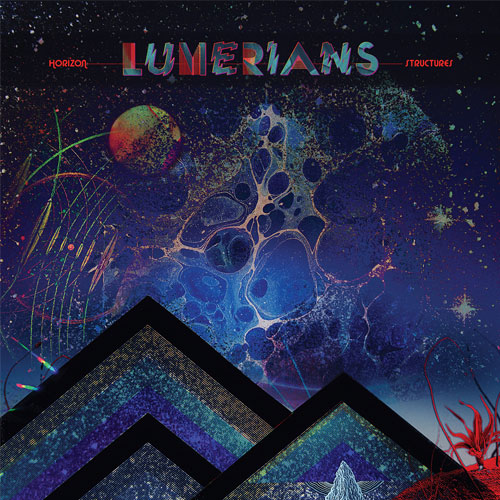
On their 2012 EP, Horizon Structures (Knitting Factory), Lumerians closed the year with a wicked set of angular, synth-driven dance music. One of the elements that sets Lumerians apart from other psychedelic acts is their embrace of key-based songs, as well as their robust approach to percussion. Accompanying their latest EP, the group offered another specific scenario for celebration and consideration (from their press summary at Knitting Factory records):

“Lumerians Horizon Structures EP leads off side A with 
“The Bloom” -- a long-fused charge of anti-apocalypse 
rock. Change is not the end. Life persists. The world is not 
ending, but YOU are. The notion of apocalypse places undue 
significance to the brief tenure of Homo sapiens. “Wintersong” 
affirms preparedness is acceptance of the inevitable. Side B 
closes with two heavily synth layered dance numbers. 
“Tawazula” and “Lazer Barn,” dances of creation and 
destruction in that order and out of order.”

Combined with Transmalinnia’s exploration of dreams, ideas, and visions traveling to undiscovered worlds, one might be forgiven for considering Lumerians to be spacey contributors to the psychedelic movement. Yet, their 2012 work deserves more attention for its emphasis on the earth itself, especially the idea that places the apocalypse in the center of a life-persisting change on earth. Not a change in which we focus on our own demise, but perhaps one in which we embrace the triumph of life in all its formations. Here we uncover the depth of vitality, and affirm that life itself persists in ways beyond our own understanding or existence. Accompanying their framework that embraces the use of dreams -- especially using forms of art to explore a world of dreams, ideas, and visions -- Lumerians add another dimension to their purposeful rock. We can use these artistic tools to explore life itself.

Telos is a purpose, or an end. One common mistake people make when they argue against telos is using the assumption that “an end” or “a purpose” results in some sort of pre-determination. Naturally, it is difficult for humans to wrap their minds around the idea that they are driven toward greater purposes without feeling that their ability to act or think is impaired. We want to feel “free” in some significant way --which, in itself, might suggest some specific human purpose -- but we do not want to focus specifically on the ends that humankind can achieve. Our own skepticism, or our perception of moral ambiguity in the world, leads us to ask, “whose end, or whose purpose?” How can we fully understand a greater human purpose without falling prey to humans that mislead us about our purposes?


In this regard, Lumerians’ embrace of dreams, exploring a world of ideals, as well as purposes or ends that disconnect the earth from humans, or disconnect our own sense of importance from vitality or life itself, provide a strong template for thinking about purpose. Remarkably, the goals of their releases in 2012 correspond with their philosophical statements. Between Transmalinnia and Horizon Structures, the group used Transmissions from the Telos: Vol IV EP (Permanent / Hands in the Dark) and The Weaning and The Dreaming tape (Sanity Muffin) to explore their own vision, expose the structures to their song-oriented LPs and EPs, to unveil their logic.

Following the second half of Transmalinnia, the four untitled cuts on Transmissions from the Telos show the band moving deeper into their instrumental territory. Here, the group combines laid-back grooves that show the fall-out of the dense sound of their LP, instead opting for rollicking percussion and playful key sequences. Alongside a playful fusion of psychedelic and jazz instrumental sounds on Transmissions…, the group present longform ragas and expansive, dark drones. It almost sounds like the band drew from each individual element that appeared on their LP, and expanded those elements into their own statements. With these instrumental sequences, Lumerians stretched their world, and added several different vantage points or signposts to their vision.

We can understand how to expand these vantage points by exploring the extreme poles. On The Weaning and The Dreaming cassette, the group presented two tantalizing titles for their tape manipulation compositions: “Consciousness without an Object,” and, “An Object without Consciousness.” Multiple sources have written about how the group built these compositions, which involved recording percussion, synth, and bass parts both forwards-and-backwards; each side of the tape is the full piece played in both directions (I call them “compositions,” even though there is basically one performance or construction, because the end result of the active tape manipulation is quite different on both sides. One wouldn’t necessarily know that it’s the same performance played forwards and backwards unless they were told). Their titles for these compositions provide the extreme poles for expanding our vantage points for exploring our purpose.


In philosophy, there are two extreme poles of perception that receive a lot of attention (and, form most traditional problems): realism and idealism. In their most exaggerated forms, realism upholds some realm of objects that exist independently of consciousness, while the most extreme idealists uphold perceivable realms that only exist through mind or consciousness. While these are extreme reductions on my part, Lumerians’ explorations of these two sides of reality are rich and continue to unfold with multiple listens. “Consciousness without an Object” leans heavily on sparse, backwards percussion, ultimately presenting structural outlines that lead into sparse synth drones and shimmering flourishes. These percussive blips, decaying in a surreal way thanks to the backwards tape, are beyond ritual or beyond repetition; they unleash sheer creativity, presenting a borderless plane for thought. By contrast, “An Object without Consciousness” is frantic, direct, vital, and engaging, emphasizing immediate, concrete experience that channels the rumbling, rattling hum of a world that exists through sheer independence.

These vantage points showcase numerous points of origin for a purpose-driven project. We need not conclude that humans striving toward a purpose results in one specific outcome. Rather, Lumerians show a strong communion with purpose-oriented projects by embracing the potential of each outcome, and ultimately, embracing the process that leads to those purposes. For this reason, Lumerians are one of the strongest psychedelic acts, not simply because their music corresponds to their philosophical and artistic vision, but also because their music offers a template for exploration that ultimately leads to action. This is why it’s important to take Lumerians’ philosophical hints seriously: if we follow their cues, and use our dreams, ideas, and visions to explore the world, and we investigate our purpose in a way that upholds life-itself (instead of simply upholding human existence), we can more meaningfully orient ourselves to the people, companions, objects, and places in our lives.

It is not a sucker’s game to associate psychedelic music with soul-building or mind-building exercises. Lumerians prove that through psychedelic exploration, we have a strong set of tools, sounds, and artistic forms that can orient ourselves to our universe. This orientation can ultimately lead us to better understand life and, as a result, become better humans, truly manifesting mind and soul.

Nicholas Zettel is a former contributing writer for Foxy Digitalis. He will be joining the rest of the Foxy D crew in the move over to the forthcoming Decoder website.